| USAPL Records: What, When, Where and How much! By: Steve Mann USAPL National Referee June 5th, 2003 |
The purpose of this arctcle is to answer what is probably one of the most
often asked questions in Powerlifting today. "What records can I break
in this contest." So this article is to try to make sense of the USAPL
record books and how it counts. This is not a complete list of ALL the
rules to records. The purpose is of this article is to hit the high notes
or the most confused part of records in the USAPL. I am trying to cut down
confusion here, so if there is something that doesn't sound right or is
just plain wrong from your understanding of the rule, please contact me
at steve@purepowerlifting.com. Again this is not a complete list of requirements, so take that into consideration before contacting me.
Now first the What, When and Where
State Records
State Records should only be allowed to be broken by USAPL card holding
members of that state. This is normally determined by the address on your
membership card. The details to what state records you are eligible to
break and in what meets is up to your state's administration. Most states
require you to weigh-in the day of the contest to be eligible for state
records. You are also eligible to break your state records in an event
USAPL event not located in your state. Example, you are a Texas USAPL member,
but you lift at either a local or national level USAPL event in Louisiana.
If you exceed your states records, you should be eligible to get credit
for the record. Now the state record keeper needs to be notified of this
record and usually some evidence is required.
American Records
At a high level, American Records can be broken at any USAPL event with
at least 3 National Referees. It is up to the meet director to have three
National referees at his/her event, but it is not mandatory for a state
event to have National referees. Now there are 5 additional stipulations
the lifter needs to be aware of.
Additional stipulations to get credit for American Records are.
1) The lifter must weigh-in 2 hour prior
to the scheduled start of lifting.
2) The National Judges must referee your
lifts.
3) The paperwork for that lift(s) must be completed and mailed to the National
office with all the required documents. This paperwork process is best
handled by the lifter, since some records require birth certificates. This
one is the lifter's responsibility to do the day of the event. This is
just paperwork, don't loose a record because of this, it takes a total
of 10 minutes to do this at the meet, much longer after the fact.
4)The following is a stipulation related to making a certain weight in
the lifts you did not break the record in. For example, if you break a
American bench record, you must also achieve a certain weight in the Squat
and DL to receive credit for the record. I am giving the IPF interpretation
to this rule. I believe there might be a current gap in the USAPL standard
to the IPF standard. It could be fixed, but if it isn't I expect it will
be fixed to adhere to the IPF standard by this July.
(IPF Interpretation) Individual lift records must be accompanied by lifts
of at least double the lifters bodyweight on both squat and dead lift.
The lifter must achieve at least his bodyweight on the bench press, female
lifters must do one and a half times bodyweight on both squat and dead
lift . While she must achieve at least 75 percent of her bodyweight
on the bench press. All to the nearest 2.5 kg above.
5) And of course, the lifter is subject to drug testing. All open American
records are mandatory test.
Single Lift Records
Most confused part of records are the difference between a single lift
record and a full three lift record.
Well the USAPL does not currently have ANY single lift American Records. Which means you must break American
Records at full Powerlifting (3 lift events) only. Only National Single
Lift Championships have single lift records. National three lift PL Championships
also have their own Powerlifting National Records.
National Records
National Records are better defined as National
Championship Records. These can only happen
at USAPL National Championship events. For
example,to break the single lift Deadlift National Record, you must compete in the DL National Championships, which is a single
lift event. No other event is permitted to break this record. Also at single
lift National Championships you will not be able to break American records,
based on you only doing a single lift.
Since National Championships have all National
or higher ranking referees, you will not
need to worry about having the right judges.
Furthermore you will not need to worry about
weigh-in times, since National events are
supposed to all have ONLY 2 hour weigh-ins.
How much do I have to do break it?
Below is an excerpt from the USAPL rulebook defining how much records need to be broken by. This rule is defined for American Records, but is the same for State, National and International events.
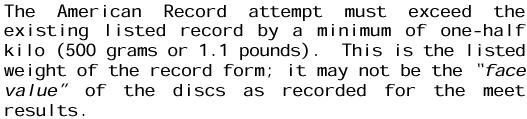
So this is some of the basics to setting USAPL records. There are many things left out that the meet director is responsible for. Make sure to ask questions and get all your records to count.
Hope this helps.
Steve Mann
USAPL National Referee